
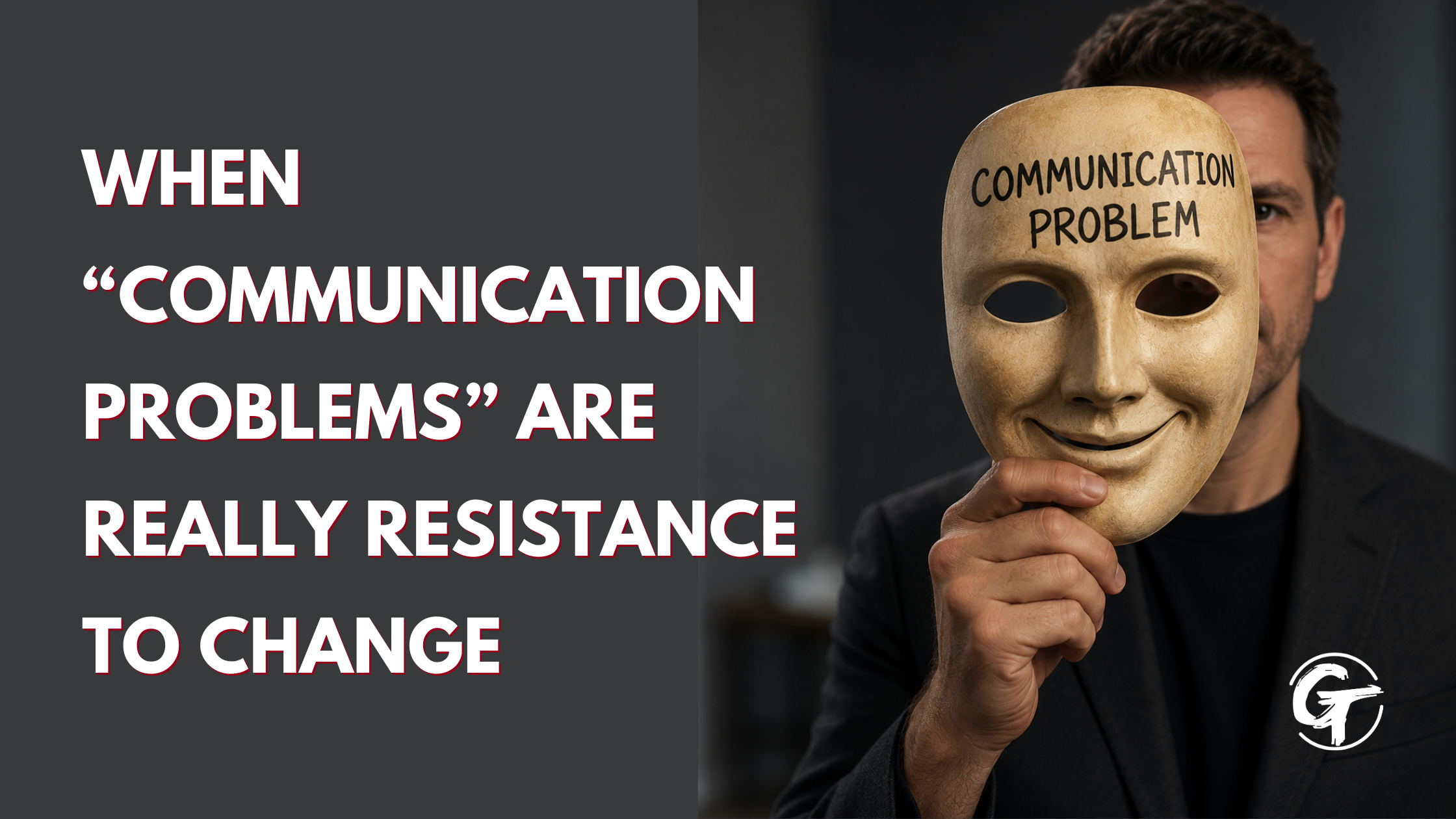
Leaders tell me they have a communication problem more often than almost anything else. Sit with the details for a while and a different picture usually shows up. What they have is a problem with change, and communication is taking the blame.
I notice this faster than I used to, and I think it’s because of where I learned to pay attention. I’ve spent decades working with leadership teams, and a good stretch of that running the improv theater I founded in 2008. Improv trains you to watch what’s actually happening between people instead of what they say is happening. On a stage with no script, the words are rarely the problem. A costume tells you who someone is pretending to be, and most of the craft is learning to see the person underneath it. The same is true in a meeting. The problem is whether two people will accept each other’s offers and build something, or whether one of them is quietly refusing while still smiling. That same pattern shows up in conference rooms every week.
Ford, Ford, and D’Amelio make the academic version of this case in Resistance to Change: The Rest of the Story. They argue that resistance gets treated as something lodged inside employees, when leaders themselves help produce it through their actions, their inaction, and their mixed messages. That reframe changes the whole conversation. The question stops being “How do we explain this better?” and becomes “What are people actually resisting, and why?”
That question sat at the center of a recent challenge with one of my clients. The pattern was familiar. Poor or lack of communication kept getting blamed for problems that were really about accountability, power, and a reluctance to let go of old ways of working. In Resistance to Organizational Change: Some Causes and Proposals for Managing It, Baruc Lasso Plaza names the usual suspects behind resistance:
- Fear of the unknown
- Lack of trust
- Loss of control
- Entrenched habits
- And yes, poor communication
Put those side by side and the point becomes hard to miss. What looks like poor communication is often fear, distrust, or identity threat in disguise, wearing the language of communication because it’s the easiest thing to say out loud.
Accountability problems don’t get solved by better messaging
The clearest pattern my client’s team exhibited was inconsistent accountability, which was most evident among long-tenured employees. Expectations get set. Expectations get missed. Then nothing happens, especially when the person has been around forever or has a protected relationship. That is not a communication issue. It is a culture issue, one where leaders resist enforcing a new standard because doing so would disrupt old loyalties and informal power structures.
Ford, Ford, and D’Amelio are useful here because they challenge the idea that resistance only comes from below. Change agents generate resistance too, through broken promises, unilateral decisions, and a failure to own their part in the process. When leaders say they want accountability and then keep excusing nonperformance from certain people, they teach the whole organization that standards are negotiable and that tenure outranks trust. On stage, you’d see it instantly: an improv performer (leader) keeps accepting the offer out loud and dropping it the moment the scene gets uncomfortable, and everyone watching learns the agreement was never real.
Senior leadership is the bottleneck
My client’s challenge points straight to where the dysfunction lives. It is stuck at the top of the leadership team. Senior leaders agree in the meeting to collaborate, then walk out and fail to back each other up. Some go quiet the moment they disagree. Others fall back on “I’m the expert, it’s my way,” which drains the energy out of the room. Employees read that behavior clearly, because they watch what leaders do far more than they listen to what leaders say.
Improv has a name for the first behavior. We call it “blocking.” Someone makes an offer, their partner nods, then refuses to build on it. A scene built on blocking dies fast, and so does a leadership team. The “I’m the expert, it’s my way” move is the same thing dressed as authority. In an improv class, I’d call it “playing high status” to protect yourself rather than serving the scene. The leader feels safer. Everyone else feels the energy drop and stops offering anything real.
This is exactly the dynamic Ford, Ford, and D’Amelio describe. Resistance is not only a reaction to change. It is a product of how the change is led. When senior leaders align publicly and default to siloed behavior in private, they create a credibility gap that no communication plan can close.
Some leaders resist because they think they’re done growing
One observation stuck with me. The organization looks nothing like it did 10 or 15 years ago, yet some leaders still run on decades-old assumptions and habits. This is resistance in one of its quietest forms. Not loud opposition, just a stubborn attachment to an identity that used to work and no longer fits.
The single hardest thing to teach a new improviser is to let their partner change them. Most people walk on stage with a plan and spend the whole scene defending it. The good ones learn to drop the plan and respond to what’s actually in front of them. Some senior leaders never make that move. They have a playbook that earned them the corner office, and they keep running it long after the field has changed.
Sandy Piderit’s Rethinking Resistance and Recognizing Ambivalence helps explain why this is so stubborn. Responses to change are multidimensional. A person can agree intellectually that change is necessary, resist it emotionally, and fail to support it behaviorally, all at once. That is how a leader can speak convincingly about modernization while still operating from the old playbook. The work isn’t to win the argument. They already agree with the argument. The work is to reach the part of them that hasn’t moved.
Psychological safety matters when leaders move between teams
My client raised a real question. When a leader moves from one area to another inside the organization, how do they build enough trust and psychological safety for honest conversations to happen quickly?
Amy Edmondson’s foundational research defines psychological safety as a shared belief that the team is safe for interpersonal risk-taking. Teams that have more of it engage in learning behaviors: asking questions, admitting mistakes, speaking candidly. A leader stepping into a new team inherits the emotional residue of every transition that came before. If people have learned that honesty gets punished, ignored, or used against them, resistance shows up as silence, guardedness, or polite agreement that means nothing. Call that a communication problem, and you miss the truth underneath it. People don’t speak freely where they don’t feel safe.
This is the part of the work where improv stopped being a side interest for me and became a method. Improvised Intelligence™, the approach I use with leadership teams, exists because the same skills that let actors take risks in front of a paying audience also let a team tell each other the truth. You learn to make an offer and survive it landing badly. You learn to support a partner’s idea before you judge it. You learn that a mistake is material to build on, not evidence that you should have stayed quiet. A leader can’t lecture a team into any of that. They build it by going first, taking the small risk, and showing that honesty here is safe. That is Edmondson’s definition in action, and a few rounds of the right exercises move a group there faster than any all-hands message ever will.
Treat the resistance instead of disguising it
Here is the practical turn. Once you stop treating resistance as a nuisance to stamp out, you can actually work with it. The instinct most leaders have is to argue harder, and the research on resistance and persuasion (Knowles and Linn) says that arguing backfires. Pushing harder on the message tends to strengthen resistance rather than reduce it. Improv says the same thing in plainer language: you don’t beat an offer (idea) you don’t like; you accept it and redirect.
Lasso Plaza offers ten techniques for doing exactly that. Mapped onto my client’s reality, they stop being a generic list and start becoming a plan.
- Listen and understand objections. The accountability pattern starts here. Before deciding that a tenured employee is just difficult, find out what they are protecting. Most objections point at something real: an unspoken loyalty, a fear of looking incompetent, a sense that the new standard erases what they built. You can’t address what you won’t hear.
- Focus on the what, let go of the how. The senior leader who falls back on “it’s my way” is gripping the how. Give people the outcome and the standard you need, then leave them room to own the method. People defend what they help build. Hand them the “what,” and you trade compliance for commitment.
- Remove the barriers. Lasso Plaza aligns with the ADKAR markers: awareness, desire, knowledge, ability, and reinforcement. The leaders who think they’re done growing are usually stuck on desire and reinforcement. They know change is happening, and they have the ability to adapt. What’s missing is a reason to want to and any signal that adapting will be noticed. Build both.
- Provide clear options and consequences. This is the direct fix for inconsistent accountability. Name the standard. Name what happens when it’s met and what happens when it isn’t. Then apply it the same way regardless of tenure. Clear consequences are how an organization tells the truth about what it values.
- Create hope. Resistance softens when people can see something worth moving toward. Show senior leaders and their teams what the modernized organization actually looks like and how their work improves within it. People will leave a comfortable present for a future they can picture and believe in.
- Show tangible benefits. Hope needs evidence. Make the benefits concrete: fewer dropped handoffs between departments, less rework, decisions that stick because the room is actually aligned. Abstract benefits get nodded at. Specific ones get adopted.
- Make a personal appeal. For the tenured leaders whose identity is wrapped up in the old way, the appeal has to reach their values, not just the org chart. Most of them care deeply about the place and the people. Connect the change to what they already want to protect, and ask for their help carrying it. Resistance often drops the moment someone feels needed rather than replaced.
- Convert the strongest detractors. The senior leader who disappears when he disagrees is not a lost cause. He’s a signal. Work with him directly. Listen, then invite him to shape part of the change. Lasso Plaza puts it plainly: the toughest opponent, once he understands the reasons, often becomes the strongest ally. A converted detractor carries more credibility with peers than any leader speaking from the front of the room.
- Demonstrate consequences. This is the hard one, and it’s the one that many of my clients have been avoiding. No change earns full agreement. After you have genuinely listened, shown the benefits, and offered a path, some leaders still won’t move. At that point, the honest question is whether that person has a viable future in the organization as it’s becoming. Letting a small number of people stall everyone else is its own decision, just an unspoken one. Naming it early and kindly is more respectful than letting it drag.
- Provide incentives. Reinforce the behavior you want to see. Incentives don’t have to be financial. Public recognition for a senior leader who backed a peer in a tough meeting, a spot in a development program, and visible credit for helping the change land. People repeat what gets noticed.
Read those ten together and a theme emerges. Every one of them assumes resistance is meaningful, not merely inconvenient. That assumption is what separates treating resistance from trying to talk it away.
The real work is leading through change
The strongest frame in my client’s situation is the one we landed on together: leading through change, with the premise that the leaders have to change too. That beats their initial desired problem to solve (“communication and prioritization”) because it names the real problem. People are not struggling to express expectations. They are struggling to embody a new standard.
Edmondson on psychological safety, Piderit on ambivalence, Ford, Ford, and D’Amelio on resistance that leaders co-create, and Lasso Plaza’s ten techniques all point in the same direction. Resistance is data on trust, fairness, fear, readiness, and leadership consistency.
There’s one improv rule that holds the whole thing together, and it’s the first one anyone learns: make your partner look good, and trust them to do the same for you. A leadership team that actually lived by that would back each other up after the meeting, build on each other’s ideas rather than block them, and treat someone else’s risk as something to protect rather than punish. That isn’t a communication technique. It’s a way of leading.
So the next time a team says it has a “communication problem,” ask the harder question. Is communication really the issue, or is resistance to change just wearing a communication costume?
If your leadership team is stuck treating symptoms rather than the cause, let’s talk. I work with organizations to uncover what’s really driving resistance and help leaders build cultures where change is accepted, trust grows, and accountability becomes part of how people work together, not just another message from leadership.
References
Edmondson, A. C. (1999). Psychological safety and learning behavior in work teams. Administrative Science Quarterly, 44(2), 350–383.
Ford, J. D., Ford, L. W., & D’Amelio, A. (2008). Resistance to change: The rest of the story. Academy of Management Review, 33(2), 362–377.
Knowles, E. S., & Linn, J. A. (Eds.). (2004). Resistance and persuasion. Mahwah, NJ: Lawrence Erlbaum Associates.
Piderit, S. K. (2000). Rethinking resistance and recognizing ambivalence: A multidimensional view of attitudes toward an organizational change. Academy of Management Review, 25(4), 783–794.
CIAT (Inter-American Center of Tax Administrations). (2025, February 9). Resistance to organizational change: Some causes and proposals for managing it. CIAT Blog. https://www.ciat.org/ciatblog-resistencia-al-cambio-organizacional-algunas-causas-y-propuestas-para-manejarla/?lang=en