
Managing Up: How To Make Sure Your Good Work Gets Noticed
Part 1 of 2: For emerging leaders
This is the first post in a two-part series on managing up. Part 1 is for emerging leaders who want their good work to get noticed. Part 2 turns the mirror around and looks at what leaders can do to help their teams manage up well.
Near the end of a recent coaching session, one of my clients told me that before we started working together, she didn’t even know managing up existed. Now she uses it all the time. Then she grinned and said the best part is that it’s “stealthy,” because the person you’re managing up has no idea you’re doing it. She called it gamifying.
I laughed, because I know exactly what she means about how it feels. But I want to spend a minute on that word “stealth,” because it’s the reason so many capable people avoid managing up altogether. It can sound like office politics or working an angle, and if you’re someone who believes good work should speak for itself, it can feel a little beneath you.
Here’s how I see it. Managing up only becomes manipulation when you hide facts, bend the truth, or try to take a decision away from the person who owns it. Done well, it does the opposite. You reduce the amount of guesswork your boss has to do by giving a busy leader clearer information, better context, and an easier path to a good decision, and then you leave that decision where it belongs.
Managing Up Starts With Knowing What Your Leader Values
My client leads the finance team for her organization. Recently they closed out their annual audit with zero findings, which is exactly the kind of result that matters a great deal and rarely gets noticed.
Her boss is not a check-in kind of leader. She doesn’t wander the halls asking how everyone is doing, and her standing attitude about finance is pretty simple: you have the people and systems you need, so of course the books balance, of course payroll goes out on time, and of course the audit comes back clean.
Plenty of people would sit on this win for exactly that reason. Why bring it up if the boss is just going to shrug and say “well, obviously”? Others would swing the other direction and oversell it, which would land badly with a leader who sees a clean audit as the baseline.
My client did neither. She went to her boss, asked for a moment of attention on the audit, and said, “We closed the audit with zero findings. As expected.”
Those two words did a lot of work. They honored her boss’s standard instead of arguing with it; they projected confidence, and they still put the result squarely in front of a leader who never would have gone looking for it. Her boss lit up, shook her hand, and told her she was proud of the work and to keep it up. My client told me that moment gave her fuel for weeks.
I want to be careful here, because “as expected” isn’t a magic phrase you can borrow for your own boss. It worked because my client had studied this particular leader and knew what she valued and how she would hear it. That’s the real skill.
Your version of this probably has nothing to do with an audit. It might be a project that landed on schedule, a deadline your team hit without a scramble, a client who renewed without any drama, or a process you fixed so quietly that nobody has to think about it anymore. Those are the wins that look like “just doing your job,” and they’re exactly the ones worth translating for your leader.
Good Work Sometimes Needs An Interpreter
A lot of emerging leaders I work with carry a quiet assumption that if they do excellent work, the right people will notice. Sometimes they do. More often, those people are juggling twenty other priorities, and your excellent work shows up as the absence of a problem, which is almost invisible by design.
The research backs this up. In a well-known Stanford experiment at a Chinese travel company, employees who worked from home were 13% more productive than their office colleagues, yet they were promoted at roughly half the rate. That study involved a specific group of call center workers, so I wouldn’t stretch it into a universal rule. It does show something I see constantly in organizations, though: output and visibility are two different things, and your career depends on both.
One caution before anyone reads this as permission to brag. Research by Christine Exley and Judd Kessler found that women described equal performance less favorably than men did, and that stronger self-evaluations increased the odds of being hired and the pay offered. Not everyone gets the same return from talking themselves up. Based on this information, I’m not suggesting you be “louder.” Instead, I recommend being clear and factual about your results, and connecting them to what your organization actually cares about.
Stop Waiting For Your Boss To Ask
Something my client said stuck with me. Her boss isn’t going to come to her and ask how things are going. If she waited for that, she’d wait a long time and probably start telling herself a story about not being appreciated.
When a leader is quiet, it’s easy to read that silence as indifference. In my experience, it’s usually bandwidth. The fix is to go to them. Researchers who study how ideas travel upward in organizations call this issue selling, and they’ve found that the people who win senior attention think carefully about timing, come prepared, and connect their issue to goals the leader already cares about.
There’s a nuance worth knowing. Adam Grant and his colleagues found that supervisors gave employees more credit for taking initiative when they saw it coming from a genuine desire to help, and when the employee wasn’t carrying a lot of frustration into the conversation. So, you can take the initiative, but check your motive on the way in. Show up to help your boss succeed, and the visibility tends to follow.
The Difference Between Informing Your Boss and Managing Up
Informing your boss sounds like “here’s what happened.” Managing up sounds like “here’s what happened, here’s why it matters to you, here’s what I recommend, and here’s what I need.” When something deserves a leader’s attention, I encourage clients to walk through four steps:
- Outcome: What happened?
- Meaning: Why does it matter to your leader or the organization?
- Recommendation: What do you think should happen next?
- Request: What do you need from them, and by when? Sometimes the honest answer is “nothing today.”
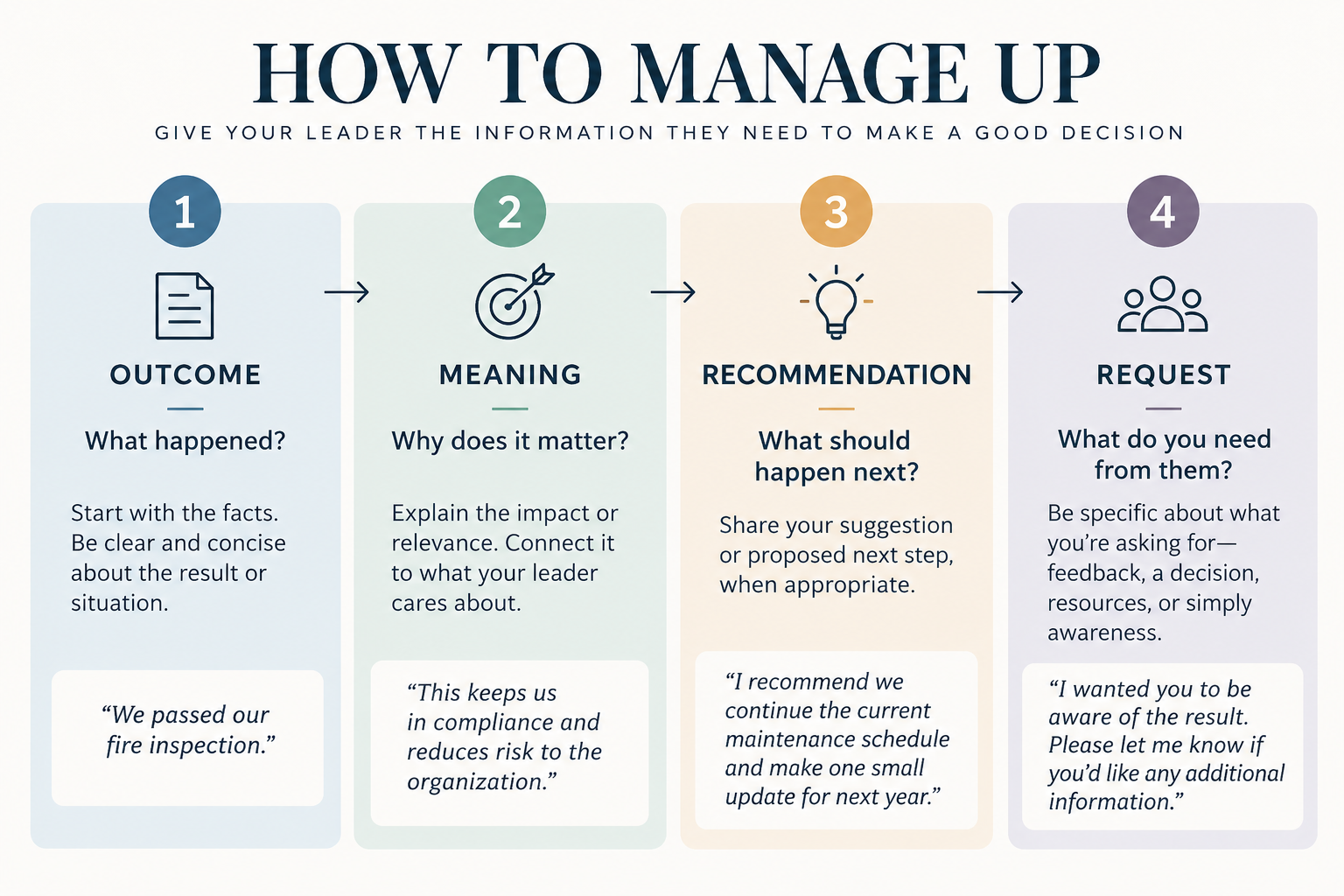
Here’s how that might sound for a routine project win: “The system migration wrapped up Friday, on schedule, as expected. Nobody lost access during the switch, so the team can start using the new reporting features this month. I’d like to run a short training for managers before the quarter ends. Nothing needed from you today, but I’m happy to share results at the next leadership meeting if that would help.”
You won’t need this for every update. Routine news can stay routine, and a two-sentence email is often the most respectful thing you can send a busy person. Save the full structure for the moments when you want a leader to notice, decide, or act.
Say It Clearly. Then Let It Go.
Managing up isn’t only about sharing wins. It’s also about what you do when you see a problem your leadership doesn’t seem worried about.
I’ve shared this phrase with my client more than once: “I can’t care more than they do.” When I catch myself getting worked up because a leader doesn’t see a risk the way I see it, I remind myself that my job is to name the concern clearly, explain what could happen, put it in writing, and then move on to the next thing I can actually influence. A risk you communicate clearly becomes a leadership decision. A risk you carry around silently becomes your private burden.
My client took this to heart. She stopped spending energy on what everyone else around her was doing and started pouring it into her own responsibilities. She credits that shift, more than anything else, for the exceptional performance review she received this year.
One important boundary: letting go of the outcome doesn’t mean walking away from legal, ethical, or safety obligations. If something could genuinely hurt people, keep escalating and keep documenting. For everything else, say it well, and then trust the people who own the decision to make it.
Managing Up Means Choosing the Right Communication Channel
In a lot of the organizations I work with, people default to email for anything uncomfortable. I’ve watched a perfectly reasonable request go sideways because it arrived as an announcement (“here’s what I’m doing”) instead of a conversation (“can we talk about this?”). The sender meant no harm, but the reader heard a declaration, and what would have been a quick “yes” in person turned into a conflict.
Communication researchers have a name for this. Media Richness Theory suggests that the more ambiguous or sensitive a message is, the more you need a channel with tone of voice, facial expression, and the chance for immediate back-and-forth. Email is fantastic for facts, follow-up, and keeping a record. It’s a risky place to make a request, work through a disagreement, or deliver anything that could be read more than one way.
My rule of thumb: use email to confirm a conversation, not to avoid one.
Eventually, You Have to Ride the Bike
Another client described coaching with me in a way I haven’t been able to stop thinking about. He said it’s like learning to ride a bike. I hold the handlebars until he finds his balance, but then I don’t go back inside and shut the door. I sit on the front steps and watch him circle the block, and if he falls, I might suggest he try turning right for a change so his arm doesn’t fall asleep.
Managing up works the same way. You probably won’t be smooth at first. You’ll overprepare for a meeting that goes somewhere else entirely, pick the wrong moment, or say too much. That’s fine. Every lap around the block teaches you a little more about how your leader thinks, what they value, and how they want to hear from you. Eventually you stop thinking about the pedals and just ride.
And remember, it’s your bike. Your boss can cheer you on, but you’re the one who has to pedal.
Ready for the other side of the desk? In Part 2, Hot Potato Leadership: Stop Catching Every Problem Your Team Throws at You, I share what leaders can do to make it easier for their teams to bring them the information they need.
Ready to help your emerging leaders communicate with greater confidence and manage up more effectively? Let’s talk about leadership coaching for your team. Message me at gina@ginatrimarco.com.