
Hot Potato Leadership: Stop Catching Every Problem Your Team Throws at You
Part 2 of 2: How leaders can teach their teams to manage up
This is the second post in a two-part series on managing up. If you missed Part 1, Managing Up: How To Make Sure Your Good Work Gets Noticed, you can read it here.
In Part 1 of this series, I wrote about managing up from the employee’s side: learning what your leader values, making your work visible, and bringing your boss the information they need to make good decisions. This time I want to turn the mirror around, because managing up doesn’t happen in a vacuum. Whether people on your team learn to do it well depends a great deal on you.
That’s not just my opinion. Gallup has found that managers account for at least 70% of the variance in employee engagement across business units. Your people’s experience of work runs through you, including whether they feel equipped and encouraged to bring you problems, wins, and ideas in a way you can act on.
I’ll be honest that I’m writing this one as much for myself as for anyone else, because I recently had a moment that tested exactly this.
When Every Problem Becomes Your Problem
One of my team members made a commitment she could no longer keep. That happens, and on my team the expectation is clear: if you can’t honor a commitment, you find someone who can cover it. She knew that. She reached out to one specific person, and that person wasn’t available.
Then she sent me an email. It laid out the facts, and that was all it did. There was no suggestion, no second option, and no plan. Reading it felt like a game of hot potato. She had made her attempt, and now the problem was mine.
I’ll admit my first instinct was to grab the potato and start solving. Instead, I asked her a coaching question: “It sounds like we still need someone to honor this commitment. What’s your suggestion for a solution?”
In this case, there wasn’t a great answer. We ended up settling for a partial solution, and I had to be clear with her that going forward, a partial solution or no solution wouldn’t meet our standard. Three days later, she resigned. She told me she realized she couldn’t meet our expectations around commitments.
When I look back on it, I can see two things at once. I hadn’t enforced the standard consistently enough before that moment, and that’s on me. I also don’t regret refusing to become the person who absorbs every problem that lands in her inbox. Notice, too, that her email was a textbook example of informing instead of managing up. She gave me the outcome and stopped there, with no meaning, no recommendation, and no request.
Coach Employees to Solve Problems Instead of Passing Them Up
It’s almost always easier in the moment to say “I’ll just do it myself.” You know the work, you can get it done faster, and you skip an awkward conversation. But every time you catch the hot potato, you teach your team that tossing it to you is how problems get handled. You set a precedent that lets people off the hook, and it quietly taxes you and eventually the whole team.
That tax is real. A meta-analysis covering more than 38,000 employees linked the ability to mentally detach from work with lower exhaustion, better sleep, and better well-being. It’s hard to detach from work when you’ve made yourself the landing spot for everyone else’s unfinished problems.
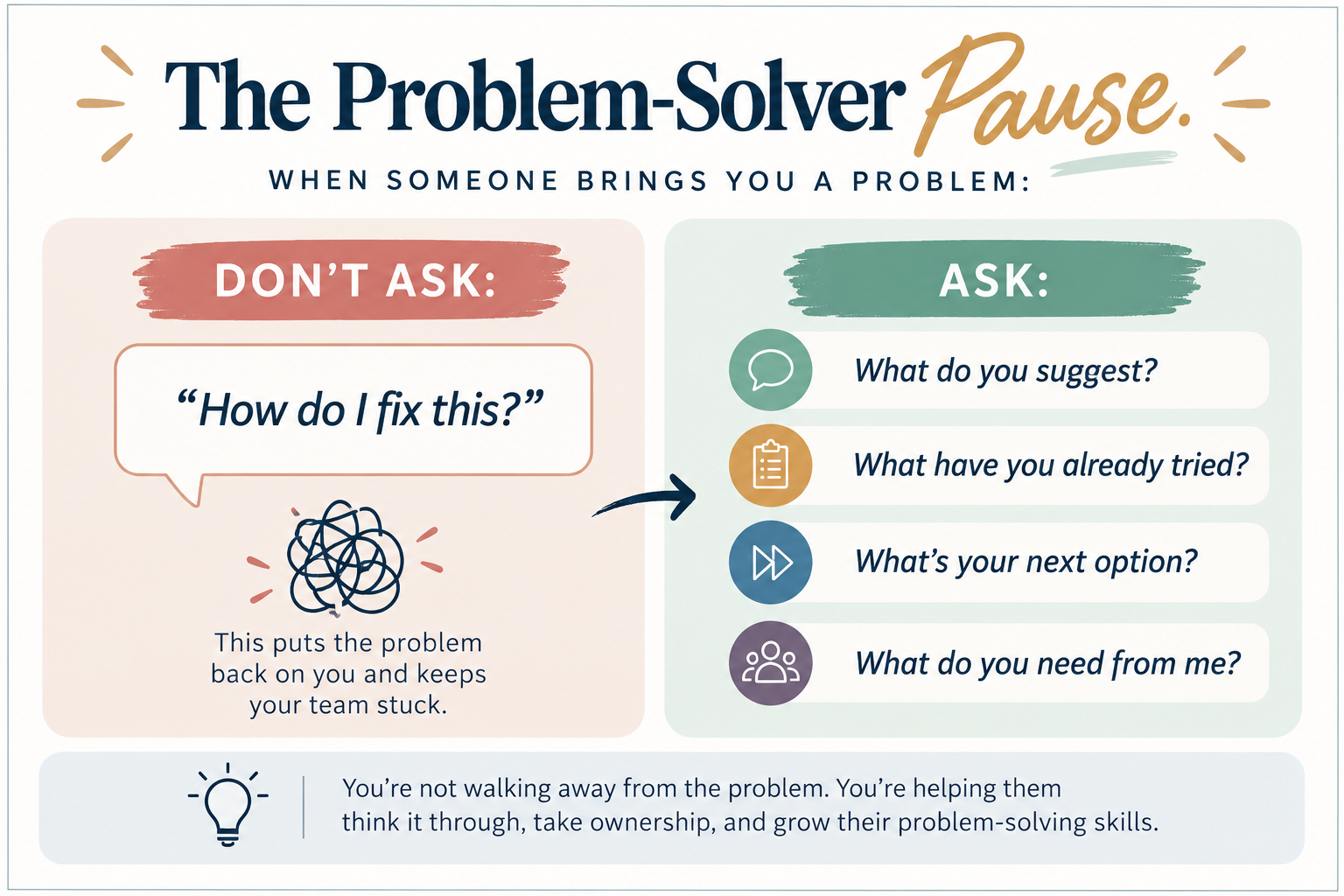
A coaching question is the simplest tool I know for handing the problem back without abandoning the person. Asking “What do you suggest?” or “What have you already tried, and what’s your next option?” tells your team member that you’re still in it with them and that you expect them to bring their thinking along with the problem.
Tell Your Team What “Good” Looks Like
My biggest lesson from that experience is that a standard only works if people know it, see it modeled, and watch it get enforced every time. I had the rule, but I hadn’t held it firmly enough, so it’s not surprising that the moment it mattered felt like a shock to her.
If you want your team to manage up well, spell out what you want to receive. In Part 1, I shared a four-part structure for emerging leaders: the outcome, what it means, what they recommend, and what they need from you. Give your team that same structure, or your own version of it, and then ask for it consistently. When someone brings you only the first piece, respond the way I did, with a question that invites the rest.
Research on proactive behavior backs this up. A 2026 meta-analysis of 308 studies with more than 107,000 participants found that people take initiative at work when they feel capable of doing it, have a reason to, and feel energized to. Leaders influence all three. Clear expectations build the “can do,” connecting the work to the mission builds the “reason to,” and how you respond when someone steps up has a lot to do with the energy.
Make It Safe To Bring You Bad News
Holding a high standard only works if people feel safe coming to you when things go sideways. If the last person who brought you a problem got their head bitten off, nobody else is going to walk into your office with a recommendation. They’ll send a short email and hope for the best, which is exactly the passive communication I wrote about in Part 1.
In a study of employees across a restaurant chain, researchers James Detert and Ethan Burris found that managerial openness was the leadership behavior most consistently tied to employees speaking up, and that psychological safety explained much of that link. People speak up when they believe it’s safe and worth it.
Trust is the foundation underneath all of this. A meta-analysis of leader-member relationships found that higher-quality relationships between leaders and employees were linked to better task performance and more going above and beyond, and trust in the leader was the strongest factor explaining why. The researchers also found evidence that the relationship drives performance, rather than performance simply earning a better relationship. In other words, you don’t wait for people to prove themselves before investing in the relationship. The investment is part of what helps them perform.
Recognize People When They Get It Right
Remember the client from Part 1 who told her boss the audit came back clean, “as expected”? Her boss shook her hand and said she was proud of the work. My client told me that moment carried her for weeks. That’s what it looks like when a leader closes the loop.
Gallup’s research on this is striking. Employees who strongly agree they receive valuable feedback are five times as likely to be engaged, 57% less likely to report burnout, and 48% less likely to be looking for another job. When employees get both feedback and recognition from their manager at least weekly, 61% are engaged, compared with 38% of those who get weekly feedback but less frequent recognition. These are associations rather than proof of cause, but the direction is hard to ignore.
Fairness matters here too. Only 26% of employees strongly agree that they get recognition on par with peers who perform at the same level. If you only notice the people who are comfortable promoting themselves, your quieter high performers will conclude that good work doesn’t count. Make a habit of looking for the results nobody announced.
Coach The Problem. Don’t Rescue The Person.
In Part 1, I shared my client’s description of coaching as teaching someone to ride a bike. You hold the handlebars until they find their balance, and then you sit on the steps and watch them circle the block. When I think about the “tag, you’re it” email, I realize that rescuing her would have meant climbing onto the bike and pedaling for her. It might have solved that week’s problem, but it wouldn’t have taught either of us anything.
In Part 1, I shared a client’s description of coaching as teaching someone to ride a bike. You hold the handlebars until they find their balance, and then you sit on the steps and watch them circle the block. When I think about the hot potato email, I realize that rescuing her would have meant climbing onto the bike and pedaling for her. It might have solved that week’s problem, but it wouldn’t have taught either of us anything.
The research on coaching supports taking the slower road. A meta-analysis of 37 randomized controlled trials found a moderate positive effect of coaching, and another review of controlled studies found the strongest changes showed up in behavior rather than attitudes. That’s encouraging for leaders, because behavior is exactly what we’re trying to build when we teach people to bring us solutions along with their problems.
So, the next time someone tosses a hot potato onto your desk, resist the urge to catch it and start solving. Ask the question. Set the expectation. Help them think through their options without taking ownership away from them.
Great leaders don’t become the Chief Problem Solver. They develop better problem solvers.
Give your people the expectations, safety, coaching, and recognition they need to get better at it … one problem, one decision, and one lap around the block at a time.
Want to share the employee’s side with your team? Send them Part 1.
Ready to help your leaders coach stronger problem-solvers instead of becoming the Chief Problem Solver? Let’s talk about leadership coaching for your team. Message me at gina@ginatrimarco.com.