I never expected a dying tree in my backyard to teach me something about workplace culture. But after years of replacing trees, hiring landscapers, testing soil, and spending money trying to fix the problem, I finally realized something leaders often miss: sometimes the problem isn’t what you’re planting. It’s the environment you’re planting it in.
I’ve been fighting with one side of my backyard for years. We live on a pond, and I didn’t want a fence blocking the view, so I decided to use trees to create a natural barrier along both sides of the house.
The original trees were arborvitaes, chosen because they were supposed to be hardy enough to handle almost any environment. Or at least that’s what we were told, and we trusted the landscapers. They were the experts. They knew more about trees, soil, and drainage than we did. In many ways, they were our consultants. We hired people who supposedly understood the problem better than we did, listened to their recommendations, spent the money, and followed their advice, repeatedly.
On one side of the yard, it worked. On the other, the arborvitaes kept dying.
At first, the explanations were simple. We weren’t watering enough. Then maybe we were watering too much. Maybe we’d gotten bad trees, so we needed different ones. As the advice kept changing, and the money kept adding up, so did the confusion. We replaced the trees, and then replaced them again. Eventually, a landscaper tested the soil, but even that didn’t get us to the root of the problem. We were still asking what we needed to do differently to keep the trees alive, not whether the question itself was wrong.
We hired another landscaper. We had custom planter boxes built, thinking raised beds might solve it. Then our HOA made us remove the boxes, which left us with a muddy mess, so we replaced the grass and started over again.
Finally, a third landscaper gave us a different diagnosis. The problem wasn’t really the trees. It was the environment. Our community has heavy clay beneath the grass, and the way our property slopes causes water to collect in certain spots. One side drains reasonably well. The other stays saturated. Suddenly, all those dead arborvitaes made sense. It didn’t matter that they were supposed to be hardy, or that we’d been told they could thrive almost anywhere, and it didn’t necessarily mean every landscaper before this one was incompetent. We had been treating the symptoms without understanding the system.
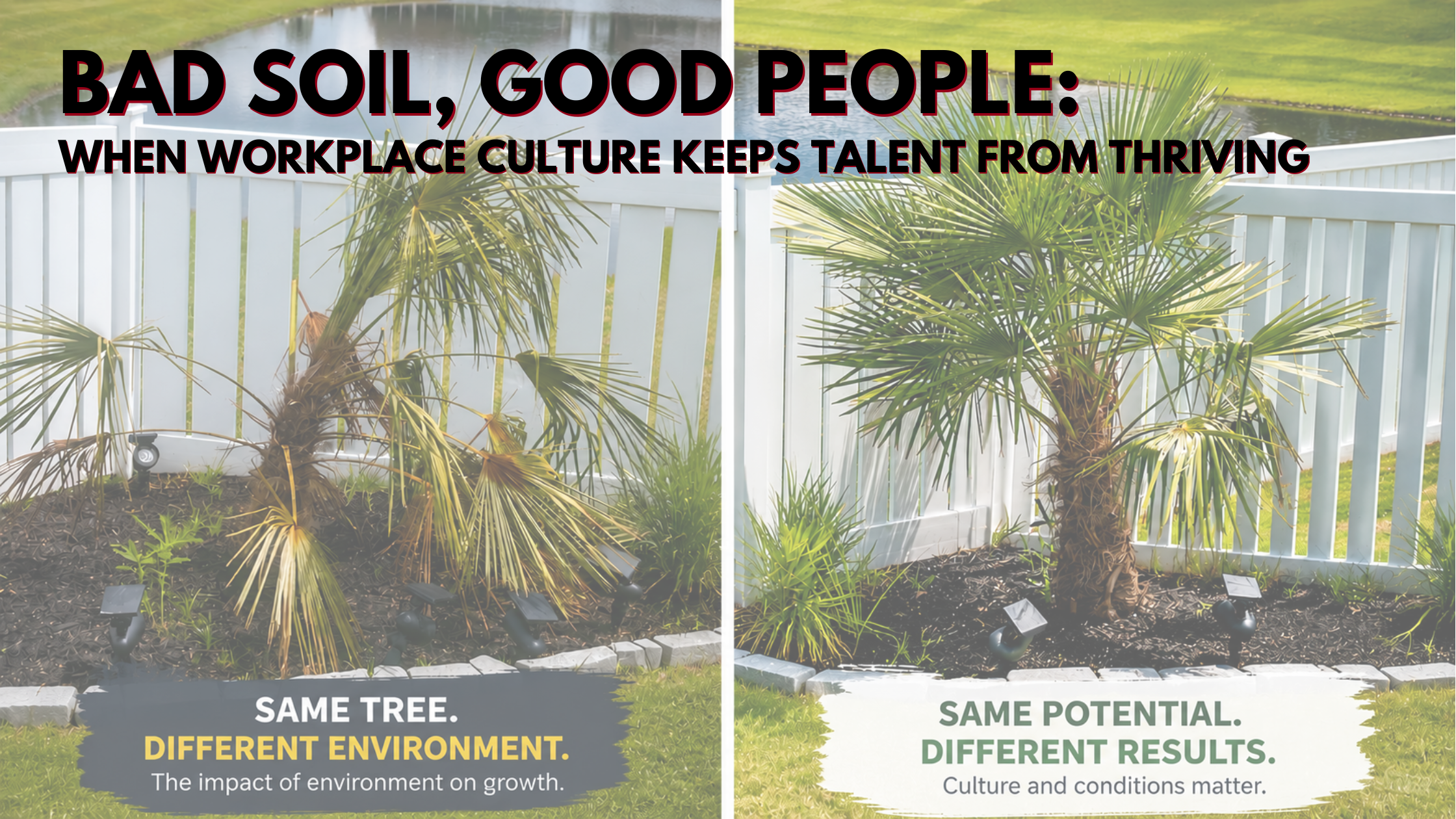
Still determined to make something grow there, I researched a new species – palm trees that could survive our climate, confirmed they were safe for our dogs, got the HOA’s approval, and had two planted. One is flourishing. The other is slowly dying. Same yard, same landscaper, same homeowner. Just a different environment within a larger one.
Watching that second palm decline, I realized I’d seen this exact thing happen inside organizations.
When the Environment Is the Problem
Organizations do this all the time. Someone struggles, so we assume we hired the wrong person and replace them. The next person struggles too, so maybe they’re not right for the role, and we reorganize. We move responsibilities around, add training, hire a coach, change processes, bring in another person. Sometimes we bring in outside experts and consultants because we assume they’ll see something we don’t. That’s exactly what I did with the landscapers.
Speaking as a consultant myself, there’s nothing wrong with bringing in expertise. An outside perspective is often exactly what we need. But expertise isn’t magic, especially when you don’t embrace it. A consultant can recommend a great tree. A leadership expert can recommend a great practice. A trainer can teach a proven model. An HR professional can help you recruit an exceptional employee. But even the best solution can fail if we don’t understand the environment we’re putting it in.
My arborvitaes weren’t necessarily bad trees. The recommendation wasn’t necessarily bad advice. The conditions just weren’t right for the solution. That distinction matters.
Sometimes people are ready for us, but we aren’t ready for them.
Why Good Employees Struggle
There’s another parallel in those arborvitaes: they were supposed to handle almost anything. We say versions of that about people too. They’re experienced; they should be able to handle this. They’re a senior leader; they should know how to navigate this. They’re highly qualified, they should be successful here. Other people seem to manage it, so why can’t they?
But resilience doesn’t make someone immune to their environment. A hardy tree can still die in bad soil, and a talented employee can still burn out in a dysfunctional culture. Great people struggle when expectations are unclear, communication is inconsistent, trust is low, resources are inadequate, leadership is ineffective, or problems go unresolved. Eventually, if enough good people struggle in the same environment, we have to stop assuming we just keep buying bad trees.
The Cost of Misdiagnosing Turnover
Think about how much money organizations spend repeatedly replacing talent without ever fixing the conditions that caused people to struggle in the first place. Recruiting, onboarding, training, lost productivity, burnout among the people who stay, leadership time spent filling gaps, consultants brought in to solve symptoms instead of causes. It adds up fast, and it’s exactly what we did in our yard. New trees, new landscapers, soil tests, planter boxes, new grass, an entirely new species. Every intervention seemed reasonable on its own, but we kept planting into an environment we hadn’t fully understood.
Organizations do the same thing. We keep planting another tree in the same saturated soil and wondering why this one didn’t make it either. At some point, the question has to change from “what’s wrong with this person?” to “what is happening in this environment that makes it difficult for people to succeed?” Until we understand the deeper conditions, nothing we plant there has much chance of growing.
Study What’s Thriving
The other lesson from my yard is that the answer may already be sitting a few feet away. One palm tree is thriving, so instead of focusing only on what’s wrong with the dying one, I also need to study what’s right about the healthy one:
- What conditions does it have that the other tree doesn’t?
- How does the water drain differently?
- What’s different about the soil?
- How much sunlight does it receive?
- What challenges is it not facing?
Organizations can do the same thing. If one department consistently retains great people while another experiences constant turnover, don’t immediately blame the people leaving. Study the department that’s flourishing:
- What is that leader doing differently?
- How does that team communicate?
- How are expectations established?
- How are mistakes handled?
- How quickly are problems addressed?
- What makes people feel safe enough to speak up?
- What conditions exist there that could be replicated somewhere else?
Find What’s Already Working
Sometimes the best practices an organization needs aren’t sitting in a leadership book or waiting to be introduced by another consultant. They’re already growing somewhere inside the organization.
- Maybe one manager has figured out how to create accountability without fear.
- Maybe one team communicates better than everyone else.
- Maybe one department has unusually low turnover.
- Maybe employees consistently speak highly of one leader.
Instead of only studying what’s broken, study what’s working. Then ask: how do we create more of those conditions elsewhere?
Hope Isn’t the Strategy, But Hope Can Motivate
Despite everything we’ve tried in my yard, I haven’t given up on that side of it. Partly because I don’t want half my yard looking beautiful while the other half looks terrible. But there’s something deeper than that. I have hope, and I don’t mean wishful thinking.
One definition of hope I heard in a church sermon has stayed with me: hope is having a confident expectation and joyful assurance of future good. That’s very different from blindly believing everything will work out somehow. We’ve all heard the phrase “hope is not a strategy,” and it isn’t. Hope doesn’t replace diagnosis. It doesn’t fix bad soil. It doesn’t stop water from running downhill. And in an organization, hope doesn’t repair a dysfunctional culture, an ineffective manager, broken trust, or systemic problems.
But hope can motivate us to keep searching for the right strategy. It gives us a reason to believe the environment can be better, and that it’s worth doing the harder work of figuring out what needs to change. Hope isn’t the strategy. Hope is what keeps us from giving up before we find one.
Fix the Environment First
That’s where I am with my yard. Before I spend money on another tree, I need to understand why one side of the yard supports growth, and the other doesn’t, and whether I can recreate those conditions.
Leaders should do the same thing. Before replacing another employee, launching another initiative, hiring another consultant, reorganizing another department, or throwing more money at another surface-level solution, look beneath the grass. Study the soil. Follow the water. Look at what’s thriving. Find the deeper problem.
Workplace culture isn’t just what we say we value. It’s the ground beneath people, often invisible, but it’s what determines whether they can actually take root. When good people repeatedly fail to thrive in the same place, the question may not be “what’s wrong with the tree?”
The better question may be: what’s happening beneath it?