“TBD” = Two Bad Days: What Retirement Teaches Us About Employee Retention
I’ve been having a lot of conversations lately with people who are thinking about retirement. Not the financial-planning conversations, because trust me, I am not the person you want advising you on your 401(k). I’m interested in the other half of retirement planning … the part that has nothing to do with whether you can afford to retire and everything to do with what you’re retiring to.
You’d think imagining what comes next would be the fun part. For a lot of people, it’s actually the hardest.
After 30 or 40 years, work has given most of us far more than a paycheck. It’s given us somewhere to be at 8 a.m., people to eat lunch with, problems to solve, a little status, and, maybe most of all, an answer to the question “So what do you do?” Psychologist Marie Jahoda made this argument decades ago. She said employment comes with hidden benefits beyond income: it structures our time, keeps us active, connects us to other people, gives us status, and ties us to purposes bigger than ourselves. A 2023 meta-analysis tested her model and found that those less visible functions of work were linked to mental health on their own, independent of the money.
After 30 or 40 years of answering “What do you do?” with a job title, leaving that job can create a much bigger void than an empty calendar.
Some of the people I’ve talked with could financially retire tomorrow. The math works. They keep working anyway, because they have no idea what they’d be retiring to.
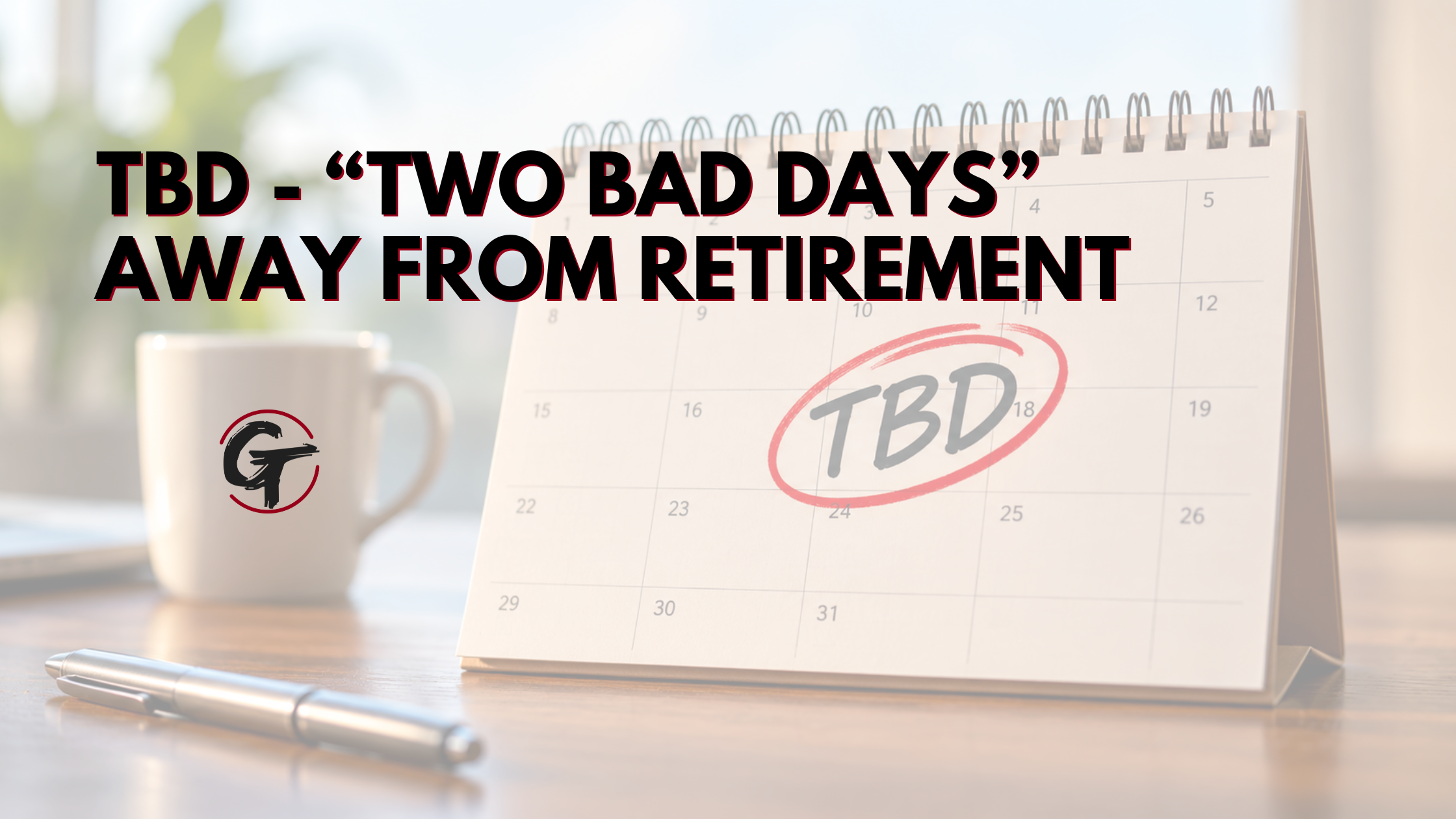
Recently someone told me their retirement date was TBD. Naturally, I assumed that meant “to be determined.” Nope. Wait for it. TBD, meaning “two bad days.” Two consecutive bad days at work and they’re out.
The comedian in me appreciated the setup and punchline immediately. The organizational-health consultant in me couldn’t stop thinking about what it meant.
Options Change Behavior: What a Full Sales Pipeline Teaches Us About Work
Think about the difference between a salesperson with an empty pipeline and one with a full pipeline.
When there is only one or two opportunities on the board, every objection feels enormous. Should I discount? Should I call again? What if they go with the competitor? Suddenly that one prospect holds an incredible amount of power over you, and you can feel yourself getting a little desperate.
Now give that same salesperson a healthy pipeline full of qualified opportunities. They don’t need every deal, so they can afford to be selective. They can spend their time and energy on the right-fit prospects and walk away from the ones who aren’t. They don’t have to chase someone who isn’t interested, discount out of panic, or keep resuscitating a deal that should have been marked closed-lost three months ago. Having options gives them the freedom to walk away … and the confidence to focus on the opportunities actually worth pursuing.
Options change behavior, and the same is true for employees.
For most of our careers, leaving a job is a big deal. There’s the mortgage, the kids, tuition, health insurance, and a career still under construction. Because of that, people tolerate things. They put up with the difficult boss, the meeting that should have been an email, the colleague who is never held accountable, the constant reorganizations nobody bothers to explain, the promise leadership made six months ago and quietly forgot, and the work that stopped feeling important years ago.
Eventually, though, some employees end up with a full pipeline of their own. It isn’t full of sales opportunities. It’s full of options for what they could do with the rest of their lives. And once someone no longer needs the paycheck, the question shifts from “Can I afford to leave?” to “Why am I choosing to stay?”
That is a very different question, and it’s one your organization has to answer.
Employee Retention Changes When People Don’t Need the Job
This is the part leaders should be paying attention to.
There may be people inside your organization right now who aren’t job hunting, aren’t polishing their LinkedIn profiles, aren’t interviewing, and aren’t threatening to quit. They may not even have a retirement date. They’re simply TBD, and you may have absolutely no idea.
These are often your experienced people, the ones with years of institutional knowledge, deep relationships, and expertise you can’t replace with a job posting. They’re still doing good work and still showing up. But somewhere along the way, their relationship with work changed. They don’t need you quite as much as they used to, which means you may need to give them a better reason to stay.
Imagine treating your most valuable employees the way you treat your most valuable clients. If losing them would be expensive, disruptive, and difficult to recover from, you probably wouldn’t wait until they were walking out the door to find out how they felt about the relationship.
The good news is that leaders have more influence over whether people choose to stay than they may realize. Peter Browne and his colleagues reviewed 46 studies on working conditions and retirement and found that people who were more satisfied with their jobs and had more control over their work both intended to retire later and actually did retire later. Job resources and social support mattered too, though the evidence there was less consistent. Here’s the part I find most interesting: the review found no consistent link between job demands and when people retired. In other words, hard work isn’t necessarily what pushes people out the door. Feeling stuck and unsatisfied is.
The reason to stay is rarely more money. It’s more likely to be purpose, autonomy, respect, interesting work, good relationships, flexibility, and the sense that their experience still counts for something. Most of all, it’s a workplace they actually want to be part of.
Two Bad Days Aren’t Really Two Days: Why Employees Suddenly Leave
There’s another reason the “TBD” comment stuck with me. I don’t think people usually retire because of two bad days. I think two bad days are often just the last two in a long line of mediocre ones.
Turnover researchers have a name for the moment that suddenly changes the equation: a shock. In their unfolding model of voluntary turnover, Thomas Lee and Terence Mitchell described a shock as an event significant enough to make someone stop and reassess their relationship with the job. It can be positive or negative, expected or out of nowhere, about work or about something else entirely. And it can trigger a departure that looks abrupt to everyone watching.
Not every sudden retirement or exit results from years of quiet frustration, though. The research describes several different paths. Sometimes a single event creates the desire to leave. Sometimes it activates a plan that was already sitting in someone’s back pocket. And sometimes it simply makes accumulated dissatisfaction impossible to ignore any longer.
From the organization’s side, all of those paths look the same. “She just decided to retire.” “We had no idea he was thinking about leaving.” “Everything seemed fine.”
Maybe everything wasn’t fine. Maybe the employee wasn’t actively planning to leave either, and frustration had just been piling up until one more unexplained decision, broken promise, dismissive comment, or pointless meeting tipped the scale. Sometimes a departure isn’t triggered by a financial milestone at all. It’s triggered by an organizational one.
Retirement Planning Is About More Than Money
Now let’s flip it around. If you can afford to retire but you’re waiting for “two bad days” to make the decision for you, you might be handing your job way too much power over what comes next. A terrible Tuesday shouldn’t get to decide the next 20 or 30 years of your life.
That’s why the retirement conversations I’ve been having aren’t really about retirement. They’re about identity, purpose, and possibility. What would you want to learn? Who would you spend your time with? What would you contribute, and what would challenge you? What would get you excited to get out of bed on a Monday morning if nobody were paying you to do it?
This isn’t just a nice philosophical exercise. Researchers increasingly treat retirement planning as having several dimensions: financial, yes, but also social, psychological, and health-related. In a study of 630 retirees in Hong Kong, people who planned their social lives and thought through the psychological side of retirement felt more confident, and that confidence was linked to better life satisfaction and physical health. Financial planning still directly improved life satisfaction, but it didn’t build that same confidence. Social planning was the one dimension linked to fewer depressive symptoms through it.
The social piece keeps coming up. A study of Australian workers in their first year of retirement found that holding onto the groups they valued, and joining new ones, supported their mental health and life satisfaction through the transition.
So, by all means, build a retirement account. Just make sure you’re also building a retirement life. There’s an enormous difference between retiring from something and retiring to something, and the time to build that pipeline is before you need it.
Retirement Doesn’t Have to Mean Losing Your Purpose
I also don’t want to suggest that leaving work automatically drains people of purpose. For some, it does the opposite. A longitudinal study of more than 8,000 American adults found that retirement was associated with an increase in sense of purpose, especially among people with lower socioeconomic status who were leaving dissatisfying jobs. For them, walking away from work wasn’t losing something. It was getting something back.
Retirement can be a loss, a relief, an opportunity, or all three at once. The real question isn’t whether work is your only possible source of identity and purpose. It’s whether you’ve developed any other sources before work isn’t there anymore.
The Employee-Retention Question Leaders Should Be Asking
People’s relationship with work changes over the course of a career, and at some point some of your most valuable people will cross an invisible line from “I need this job” to “I’m choosing this job.”
That isn’t necessarily bad news. Someone who doesn’t desperately need the job often brings more confidence, candor, and perspective, the same way the salesperson with the full pipeline does. But it does mean you can’t count on golden handcuffs forever. When people have options, you have to give them reasons to choose you.
Maybe it’s time to stop asking only “Are our people planning to leave?” and start asking “If they could leave tomorrow, why would they choose to come back Monday?”
And for those of us thinking about what comes next, there’s an equally important question: if you could leave tomorrow, what would you be excited to wake up and do the day after?
Whether we’re talking about sales, careers, or retirement, there’s real power in a full pipeline. It means you aren’t staying because you’re scared of what happens if you leave. You’re choosing from options, and that’s a much better way to live.
If your best employees could leave tomorrow, why would they choose to come back Monday?
Through Carmine Communications, I help organizations create workplaces people choose to be part of by developing stronger leaders, building trust and accountability, improving communication, and creating cultures where people can do meaningful work without needing “two bad days” to decide it’s time to leave.
Ready to give your best people more reasons to choose you? Let’s talk.
Message me at gina@ginatrimarco.com.