
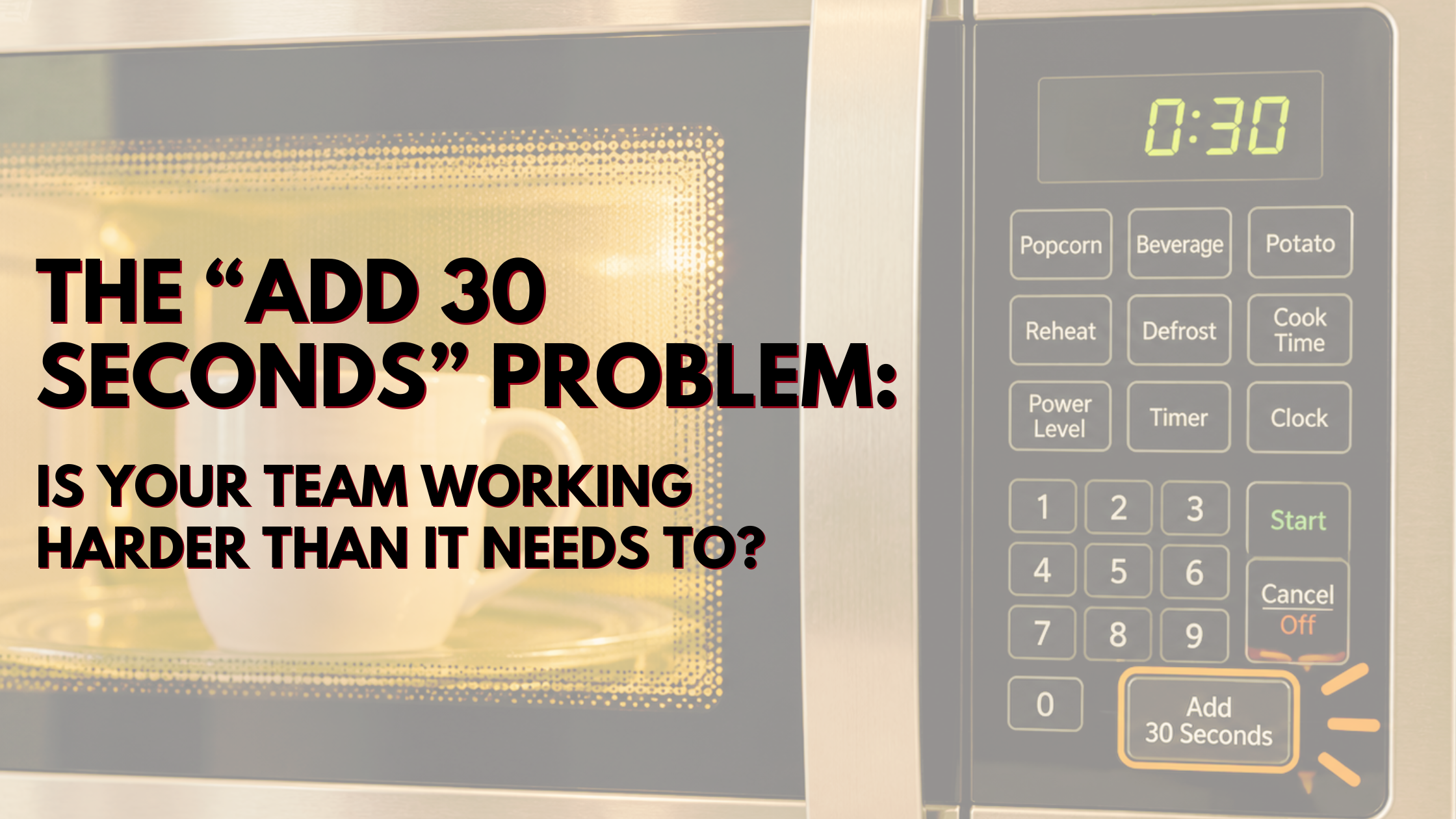
The “Add 30 Seconds” Problem: Is Your Team Working Harder Than It Needs To?
I recently learned how to use a microwave.
In fairness, I have been using microwaves for decades, and I’d like the record to show that I have never once stood in front of one begging it to warm up my leftovers. I know how they work. When I want something heated for one, two, or three minutes, I press 1, 2, or 3 and walk away without a second thought.
The one exception is my morning coffee. I heat milk to foam, and one minute makes it bubble up and over like a science fair volcano, so I only heat it for 30 seconds. That requires a little ritual: Cook Time, 3, 0, Start. Four buttons, every single morning, for years.
Then one day my husband asked me to add 30 seconds to something we were cooking. He watched me launch into my routine and said, “What are you doing? Just hit ‘Add 30 Seconds.'”
I looked down, and there it was, a button with those exact words printed on it, sitting in plain sight like it had been waiting patiently for me to notice. (It probably had.)
I felt like I was operating a microwave for the very first time. Had they snuck that button in while I wasn’t looking? Was there a memo I missed? Should someone from the manufacturer have shown up at my door for a mandatory upgrade seminar? For the record, versions of that button have been around for years, just not on every model or in exactly the same form. Nobody snuck anything past me. I simply knew how to use a microwave, so I had stopped looking at it.
It made me wonder how often the same thing happens at work; how many inefficient processes we keep repeating simply because we’ve stopped noticing there’s a better way.
When Experience Creates Blind Spots
My four-button process wasn’t broken. It worked perfectly every morning, and that’s exactly why I never questioned it.
Research on habits helps explain what was going on. Psychologists Wendy Wood and David Neal describe habits as responses linked to environmental cues. Repeat a behavior in the same setting enough times, and the setting itself starts triggering the behavior; no deliberation required. My microwave stopped prompting the question “What’s the best way to heat this milk?” and started prompting a rehearsed sequence. My fingers were doing the thinking.
There’s a second thing at play. Psychologists have studied for decades what happens when a familiar solution works well enough: it can keep us from spotting a better one. It’s called the Einstellung Effect. In the classic water jar experiments, most people who learned a longer method kept using it and missed a simpler shortcut sitting right in front of them. Later research found the same pattern among chess experts, whose attention kept drifting back to a familiar winning move even when a faster one was on the board.
Add the simple fact that my attention was on getting my coffee made, not on studying the control panel, and that button never stood a chance.
I don’t think the lesson is that experience makes us careless. Experience is a gift. It means we don’t have to analyze every familiar task from scratch, which would be exhausting. The tradeoff is that experience makes us efficient, and without deliberate curiosity, that efficiency can harden into a blind spot. The more automatic a routine becomes, the less often we stop to look at it again.
What’s Your “Add 30 Seconds” Button at Work?
The microwave is a small example of something I see in organizations all the time.
A monthly report gets built the same way because that’s how someone learned to build it. An approval process has five steps because five steps made sense eight years ago. The Tuesday meeting happens because it has always happened on Tuesday. Someone manually enters data that could be automated, a manager keeps solving problems their team is fully capable of solving, and the company pays for software features nobody has ever clicked on.
Nobody walks into work thinking, “Today I’m going to make this harder than it needs to be.” They’re just pressing Cook Time, 3, 0, Start, because it worked yesterday.
Researchers who study organizational routines, including Martha Feldman and Brian Pentland, point out that routines aren’t the enemy. They give us stability and coordination, and they can also adapt and improve over time. The goal isn’t to blow up every routine. It’s to keep a useful routine from becoming an unquestioned one. A process doesn’t have to be broken to deserve a second look, and “it still works” is often the very reason nobody notices it could work better.
Why Didn’t Anyone Tell Me? The Communication Problem
Once I recovered from my microwave awakening, a bigger question crept in. Whose job was it to make sure I knew about that button?
I’m pretty sure no appliance company was going to send someone to my kitchen. 😂 But workplaces aren’t microwaves.
When organizations roll out a new tool, process, policy, or expectation, leaders often believe the job is done once it’s announced. We sent an email. We covered it at the staff meeting. It’s in the handbook. We did a training on that.
Here’s the catch: information delivered isn’t behavior changed.
Research on implementation intentions shows why. An implementation intention is a specific plan that ties a new behavior to a moment: “When this situation happens, I’ll do this.” In one management development study, participants who wrote those kinds of plans applied what they’d been trained on about seven times out of ten, compared with about four out of ten for those who didn’t. It was a small study, so I wouldn’t treat those numbers as gospel, but the researchers also stressed that people needed real opportunities to use the new skill and support from their managers.
Compare these two messages:
- “We now have an automated reporting dashboard.”
- “Next time you prepare the weekly report, use the automated dashboard instead of rebuilding the spreadsheet, and bring any snags to Friday’s check-in.”
The first one is an announcement. The second tells people exactly when to press the new button and where to go if it doesn’t work the way they expected.
Who’s Responsible for Changing the Way We Work?
So, who’s responsible? The honest answer is both, though not in equal measure.
Employees have a professional responsibility to stay curious, learn new systems, and every so often ask themselves a few questions:
- Is there still a reason I’m doing it this way?
- Has this tool changed since I first learned it?
- Am I solving a problem that no longer exists?
Leaders, though, control far more of the environment where a change either takes hold or quietly fades. They shape the training, the communication, the time people have to practice, what managers reinforce, and whether the old way is still the easiest way. Here’s how I’d put it: leaders own the conditions for adoption, and employees own their participation in it.
There’s one more wrinkle. Sometimes people need to unlearn before they can learn. Researchers describe organizational unlearning as deliberately letting go of outdated knowledge and practices so newer ones can take hold. Installing a better button doesn’t erase years of muscle memory. If the old workflow, the old cues, and the old expectations are all still in place, people will drift right back to them. That isn’t stubbornness. It’s habit doing exactly what habit does.
Which raises a question worth sitting with: how many people on your team know about the button but work in a system that still rewards the four-button process?
Make It Safe to Question How Work Gets Done
My husband wasn’t trying to teach me anything. He just happened to be standing there while I did something the hard way. And thankfully, I could laugh about it instead of feeling foolish.
That matters more than it might seem. At work, finding out you’ve been doing something inefficiently for years can feel embarrassing. People hesitate to ask about a feature because they don’t want to look uninformed, and they hesitate to question a process because they don’t want to seem difficult or disrespectful.
Amy Edmondson’s research on psychological safety speaks directly to this. In her study of 51 work teams, teams where people felt safe taking interpersonal risks were more likely to ask for help, seek feedback, talk about mistakes, and experiment. Those are exactly the behaviors that uncover hidden buttons.
When someone on your team asks “Why do we do it this way?” or “Could this be automated?” it may not be resistance at all. It might be the first sign that someone finally noticed the button.
Fresh Eyes Find What Experience Misses
Sometimes the person most likely to spot a clunky routine is the person who isn’t inside it yet. Research on newcomers as change agents suggests that new team members can prompt established groups to reflect on how they work and consider new approaches. Those “naive” questions from the new hire are actually valuable data about your processes.
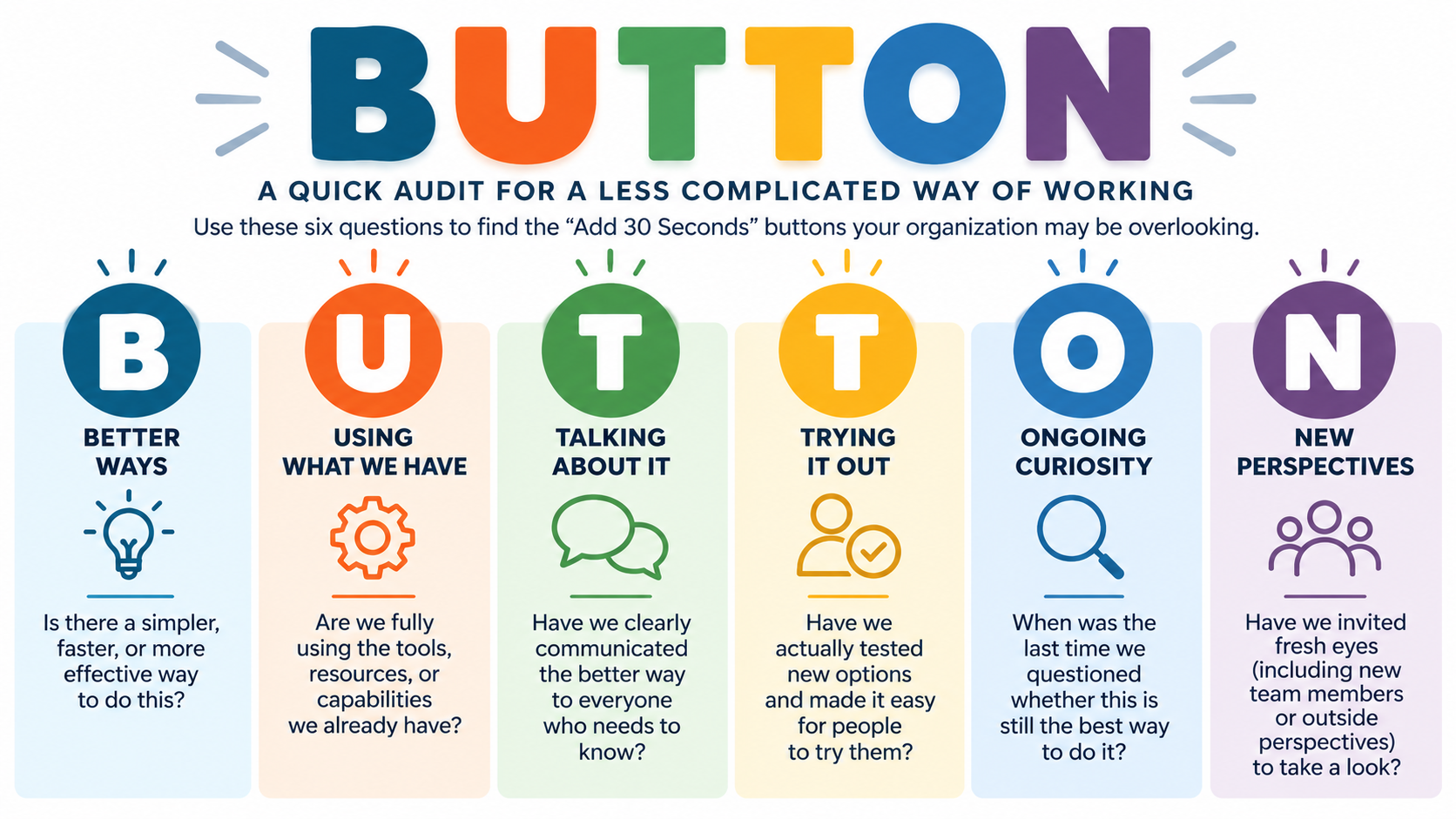
Rather than waiting for a lucky moment in the kitchen, leaders can build fresh eyes into the system. I think of it as a BUTTON audit:
- Bring in fresh eyes. Ask newer employees, customers, and people from other departments what seems unnecessarily difficult.
- Uncover the actual routine. Watch how the work really gets done instead of relying on the official process map.
- Test the original reason. Ask whether a step still solves a problem that exists today.
- Teach at the moment of use. Connect the new behavior to a specific task and the next chance to practice it.
- Open the door to questions. Make it safe to challenge a process or admit you didn’t know about a feature.
- Normalize review. Put process check-ins on the calendar so improvement doesn’t depend on someone walking by.
The Leadership Question Worth Asking
On a personal level, the question is simple:
- What’s your Add 30 Seconds button?
- What are you doing the hard way just because your current method works?
As a leader, the question gets bigger: How many people on your team are still pressing four buttons because nobody showed them there’s now one?
And if you only take one question into your next team meeting, make it this one: If we were learning how to do this today, would we still do it this way?
My husband didn’t redesign the microwave or launch a change management initiative. He just stood outside my routine long enough to see it, and he said it in a way that made me laugh instead of cringe. Sometimes that’s all improvement takes: someone who can see the routine you can’t, and a relationship safe enough for them to say, “What are you doing? Just hit Add 30 Seconds.”
What “Add 30 Seconds” buttons might your organization be missing? Let’s find the habits, processes, and ways of working that could use a fresh set of eyes. Message me at gina@ginatrimarco.com.